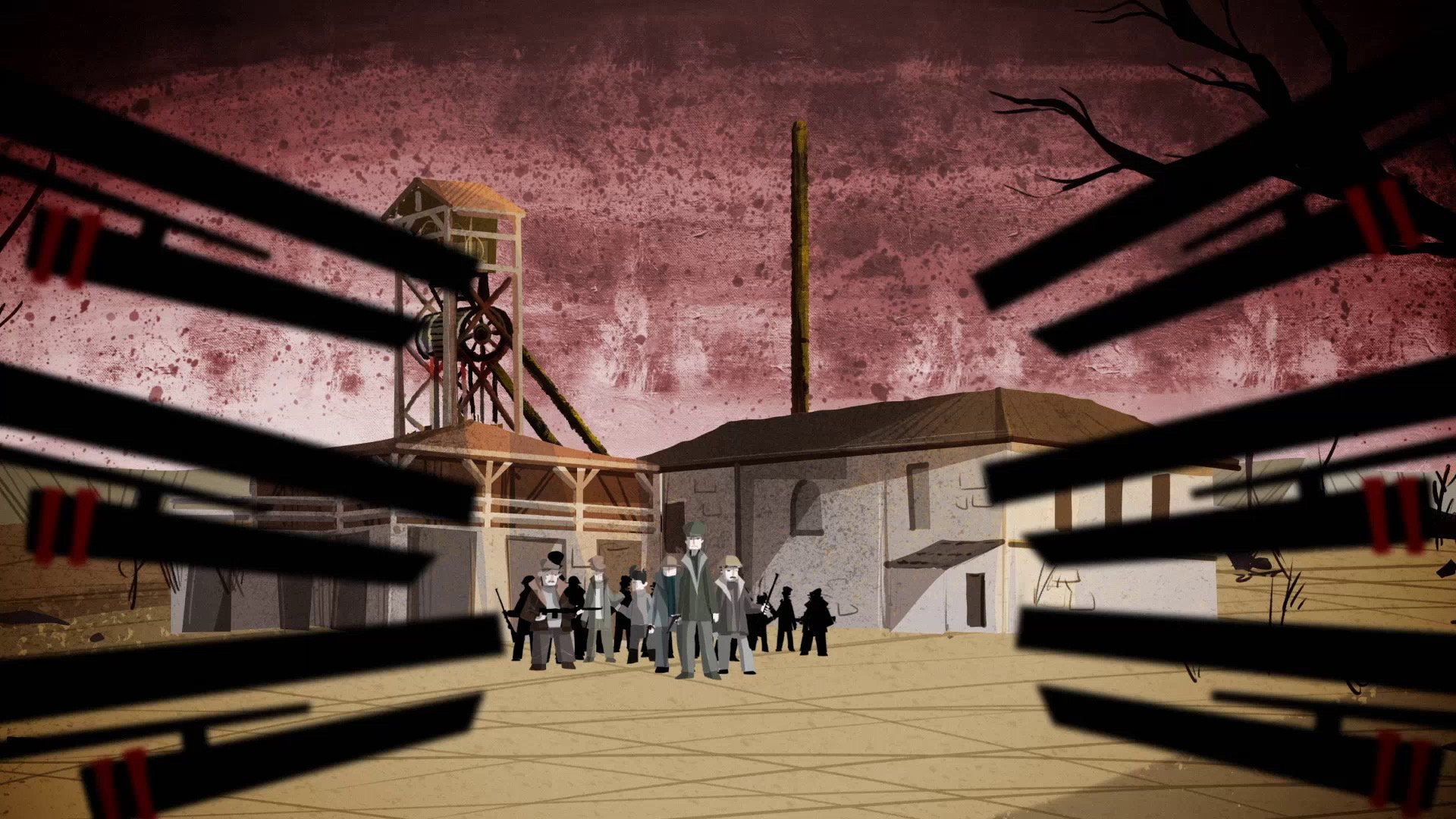
100th Anniversary overview of the Labin Republic - the world's first anti-fascist uprising.
Social & External
Narrator
During the Spanish Civil War (1936-1939) and the Second World War (1939-1945), around three thousand people managed to elude their pursuers, and probably also avoided being killed, thanks to the heroic and very efficient efforts of the Ponzán Team, a brave group of people — mountain guides, forgers, safe house keepers and many others —, led by Francisco Ponzán Vidal, who managed to save their lives, both on one side and the other of the border between Spain and France.
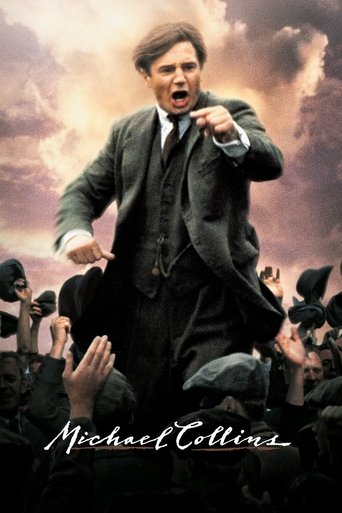
Michael Collins plays a crucial role in the establishment of the Irish Free State in the 1920s, but becomes vilified by those hoping to create a completely independent Irish republic.
The film will tell the story of the campaign of antisemitism waged by automotive pioneer Henry Ford throughout the 1920s. It was in 1925 that Aaron Sapiro, a self-made lawyer and activist, sued Ford for libel. After a dramatic court case that gripped the nation, Sapiro forced Ford to shut down his antisemitic newspaper, The Dearborn Independent, and apologize publicly to the Jewish people.
In 1924, Oskar Matzerath is born in the Free City of Danzig. At age three, he falls down a flight of stairs and stops growing. In 1939, World War II breaks out.
Petrograd, Soviet Union, 1920s. Boris Letush, devastated by a personal tragedy, feels the need to put his conscience and his principles before the demands of the cruel system he serves, where law and justice are systematically ignored.
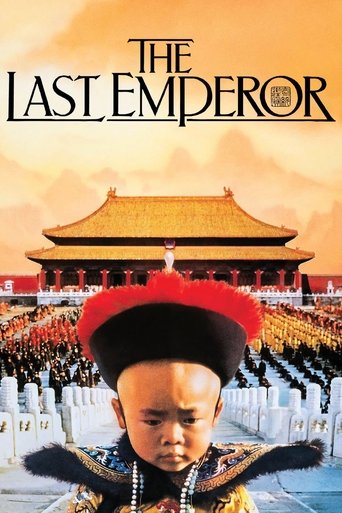
A dramatic history of Pu Yi, the last of the Emperors of China, from his lofty birth and brief reign in the Forbidden City, the object of worship by half a billion people; through his abdication, his decline and dissolute lifestyle; his exploitation by the invading Japanese, and finally to his obscure existence as just another peasant worker in the People's Republic.
In the years before World War II, a penniless Japanese child is torn from her family to work as a maid in a geisha house.
Based on the life of the Korean anarchist Park Yeol, the film shows his struggle to counter the massacre of Koreans by the government during the 1923 great Kanto earthquake, focusing on his activities as the leader of the anti-Japanese organization Bulryeongsa and his relationship with Japanese comrade Fumiko Kaneko.
Because of the power of love, the last year of Franz Kafka's life becomes his happiest. The well-known writer has never before been able to allow himself to experience intimacy, he suffers from tuberculosis and is dependent on his overbearing family. In the summer of 1923, he met Dora Diamant in the seaside resort Graal-Müritz on the Baltic Sea coast, where he is convalescing and she is working in a Jewish Volksheim. He is a man of world, the 14 years younger woman is from the deep East, he can write, she can dance. She has both feet firmly on the ground, he is always hovering a little above it. She embraces the indicative, he gets tangled up in the conjunctive. But the worldly wise Dora accepts him as he is. And he accepts her. Together they go to Berlin and when Franz's health deteriorates rapidly, to a sanatorium in Austria. They are granted a single year together until Franz Kafka's health deteriorates incurable. However their year together allows them to feel the glory of life.
When Astrid Lindgren was very young something happened that affected her profoundly, and this combination of both miracle and calamity came to shape her entire life. It was an event that transformed her into one of the most inspiring women of our age and the storyteller a whole world would come to love. This is the story of when a young Astrid, despite the expectations of her time and religious upbringing, decided to break free from society's norms and follow her heart.
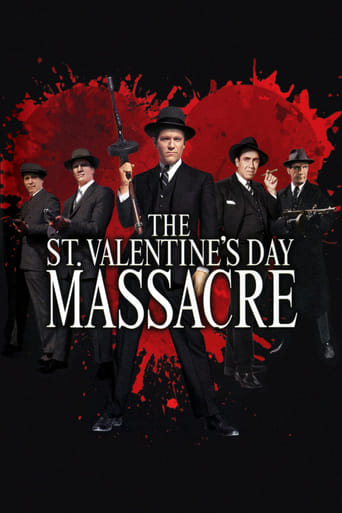
Chicago February 14th 1929. Al Capone finally establishes himself as the city's boss of organised crime. In a north-side garage his hoods, dressed as policemen, surprise and mow down with machine-guns the key members of Bugs Moran's rival gang. The film traces the history of the incident, and the lives affected and in some cases ended by it.
At the end of the Spanish Civil War, the members of a group of vaudeville performers have been stripped of everything: all they have left is hunger and the instinct to survive. Day after day, agonizingly, lost and helpless between the victors and the vanquished, the musician Jorge, the ventriloquist Enrique, the couplet singer Rocío and the orphan Miguel search tirelessly for something to eat and a safe place to live.
A walk through the landscapes of the province of Barcelona, Spain, as well as a testimony of the daily life and customs of its inhabitants.
Film journalist and critic Rüdiger Suchsland examines German cinema from 1919, when the Republic of Weimar is born, to 1933, when the Nazis come into power. (Followed by Hitler's Hollywood, 2017.)
Still today, people say that during the stormy night from March 31st to April 1st, 1922, the devil had come to Hinterkaifeck. On the farmstead near Schrobenhausen, all 6 inhabitants – 4 Adults and two children – are struck down bestially. The police did not manage to seek out the murderer(s). As the case is still unsolved as of today, the story still lives on in the minds of the people. Motion pictures, theatre plays, and the bestselling novel “Tannöd”, behind all of them stands Hinterkaifeck. Aspiring police investigators and a self-declared “Internet – special commission ‘Hinterkaifeck’” have now once again taken up the trail of the case. This exciting search for traces is followed by the film, and its findings are recreated in elaborate play scenes. Thereby, a picture of an era thought to be bygone and an idea of what really happened back then comes into existence. More precise than any fiction, the docudrama manages to get closer to the truth.
Semi-true story of the Hollywood murder that occurred at a star-studded gathering aboard William Randolph Hearst's yacht in 1924.
Finnish filmmaker and artist Sami van Ingen is a great-grandson of documentary pioneer Robert Flaherty, and seemingly the sole member of the family with a hands-on interest in continuing the directing legacy. Among the materials he found in the estate of Robert and Frances Flaherty’s daughter Monica were the film reels and video tapes detailing several years of work on realising her lifelong dream project: a sound version of her parents’ 1926 docu-fiction axiom, Moana: A Romance of the Golden Age.
The life and death of famous Korean singer, Yun Sim-deok in the 1920s.