Social & External
Unknown Role
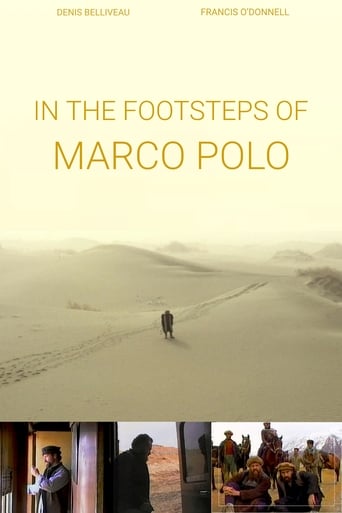
In the Footsteps of Marco Polo is a 2008 PBS documentary film detailing Denis Belliveau and Francis O'Donnell's 1993 retracing of Marco Polo's journey from Venice to Anatolia, Persia, India and China.
By filming on the actual locations traversed by Marco Polo, the series brings to life the authenticity of the local peoples from the standpoints of ethnology, historiography, culture and economics. We follow the exact route depicted in his book, Il millione, documenting the peoples, customs and cultures along the way to bring into sharp relief the cultural differences within the Asian mainland. Viewers are introduced to their development, becoming familiar with three completely different and, to us, relatively unknown spheres of civilisation and religion - Arabic Islam, Indian Hinduism and Oriental Buddhism. The host takes us through regions and cultures that may seem exotic - and, at times,dreamlike - in our search for the evidence of Marco Polo's passage.
Part two of the Mysterious China series chronicles Marco Polo's adventures and discoveries along the Silk Road as he heads toward the Mongol Empire in China. This documentary reveals the pivotal trade route as experienced and written about by the 13th-century explorer. Follow the tracks of the Venetian adventurer -- one of the first Westerners to journey into China -- and uncover the mysteries of the Silk Road.
Three people from different walks of life find themselves trapped inside a stalled elevator. What at first seems like an inconvenience rapidly escalates into a nightmare.
Set at the time of Italian explorer Marco Polo's historic expedition to China ,during the reign of Monogol ruler Kublai Khan, it stars American actor Richard Harrison as Polo. Taking considerable liberties with the historic record, the film has Polo turning up as an Imperial Inspector assigned to root out Chinese rebles in the south, but eventually being won over to their cause.
Assigned to accompany two priests on a mission to convert the court of Kublai Khan to Christianity, Marco Polo is abandoned in the mountains when the priests, doubting the very existence of China, turn back. Polo eventually pushes bravely forth alone toward the fabled country where he is accepted as an envoy into Khan's court. Marooned on the far side of the world, Polo, accompanied by his servant, Pedro, advances as a Mongol grandee for twenty extraordinary years. What he eventually brings back with him to the West is a chronicle that changed history forever.
In this globe-trotting adventure, Marco Polo (Don Diamont) plays the famous 13th Century explorer who sets out from Italy to find his missing father, and along the way finds danger, excitement, and amazing discoveries at every turn. The supporting cast includes Oliver Reed, Jack Palance, and Herbert Lom.
The Venetian traveler Marco Polo meets Kublai Khan and foils a plotter with fireworks in medieval China.
A defiant warrior-monk arrives at Kublai Khan's court in chains and soon earns his tragic nickname in this 30-minute origin story.
Young Marco Polo travels to China to help Kublai Khan fight against rebels, headed by his own son, with a new invention: gunpowder.
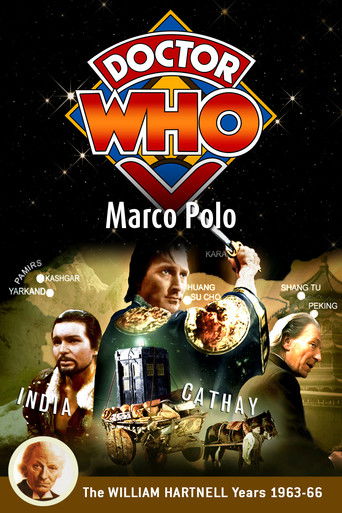
The TARDIS crew lands in the Himalayas of Cathay in 1289, their ship badly damaged, and are picked up by Marco Polo's caravan on its way along the fabled Silk Road to see the Emperor Kublai Khan. The story concerns the Doctor and his companions' attempts to thwart the machinations of Tegana, who attempts to sabotage the caravan along its travels through the Pamir Plateau and across the treacherous Gobi Desert, and ultimately to assassinate Kublai Khan in Peking, at the height of his imperial power.
Tiny meerkats survive in the harsh desert elements and follow the matriarch that is pressured to produce heirs and ensure the family's survival for generations to come.
This documentary traces the history of the B-Western from it's silent movie origins to its demise in the early 1950s. The film contains a large number of scenes from early silents and seldom seen films, as well as old photographs of the stars and one-sheet advertisements for lost films.
The extraordinary rise of Olympic boxing champion, record-breaker, feminist and LGBT icon Nicola Adams. From the streets of Leeds to the world stage, Adams fought her way to the top and changed the game. This, is her story.
Four female climbers face the sporting challenge of a lifetime as they attempt to compete in the first ever Olympic climbing competition at the Tokyo 2020 Olympics. The Wall: Climb for Gold follows four elite climbers, Janja Garnbret, Shauna Coxsey, Brooke Raboutou, and Miho Nonaka, over an extraordinary two years. They battle through Olympic qualifying events to earn their place at Tokyo, then face a gruelling season of competition and training that sees everything put on hold when the Covid-19 pandemic forces the Games to be postponed. As the young women confront their own mental and physical demons en-route to Tokyo, the film reveals an astonishing and inspiring insight into what it takes to be an Olympian and ultimately what it means to be human.
Ten young people from all over the world meet in Rome with Pope Francis with the aim of talking and conveying to him the main concerns of their generation. What awaits them is an unprecedented meeting, a face-to-face conversation, and a unique event.
Bad Boys featurette.
A journey in search of adventures, unexplored shores, empty waves in the mediterranean most secluded places living with almost zero carbon footprint. This is a surf-film about our small Ocean, the cradle of civilization and a reflection on living a simple lifestyle in symbiosis with nature. The boats together with the Onde Nostre Crew traveled the Mediterranean Sea following Ulisse's journey with surfers, sailors, free divers, musicians, artists.—Luca Merli
Jean-Luc Godard brings his firebrand political cinema to the UK, exploring the revolutionary signals in late '60s British society. Constructed as a montage of various disconnected political acts (in line with Godard's then appropriation of Soviet director Dziga Vertov's agitprop techniques), it combines a diverse range of footage, from students discussing The Beatles to the production line at the MG factory in Oxfordshire, burnished with onscreen political sloganeering.
Bert Haanstra paints a portrait of The Netherlands and the Dutch, in his own unparalleled manner. Partly with the aid of a hidden camera he observes people in the most diverse situations. He shows the unusual in the usual and the usual in the unusual. The harsh years of the post war era of reconstruction have passed and for most people life is better than before.