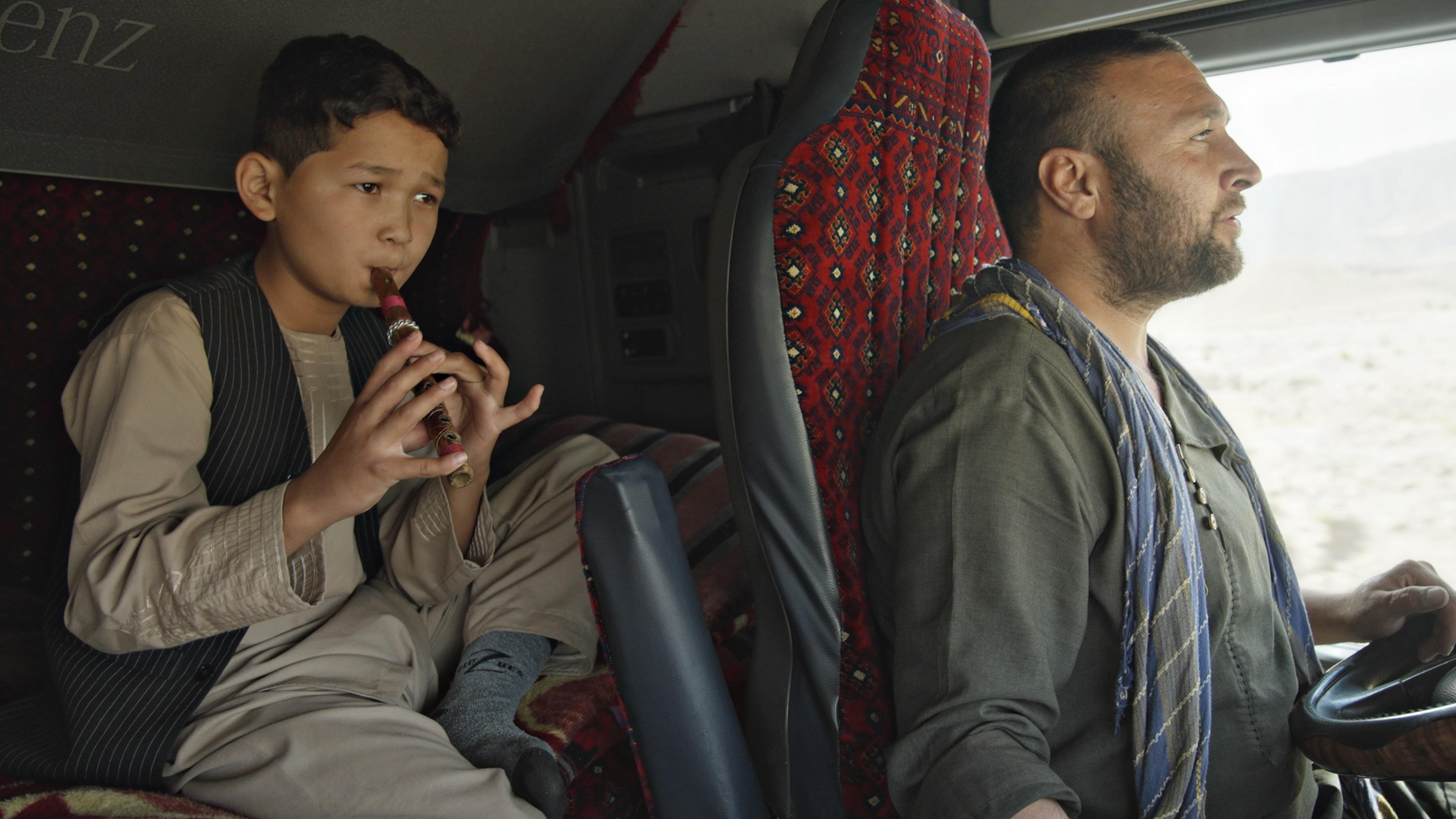
Through a child's lens, The Honest Poet reveals a rarely seen side of Afghanistan, following 11-year-old Raheem on a journey through his country and into the homes and hearts of his people.
Social & External
themselves
L, a student in India witness to the government's violent response to university protests, writes letters to her estranged lover while he is away.
One of the rooms inside the legendary Barba Azul Cabaret has become a shelter for the girls working there: the women's bathroom. Every night La Mami, who's in charge of the bathrooms, offers them the warmth and the advice they need to take on the challenge they face in the dance hall.
An exodus of migrants settled in Tijuana and they hope to cross each day regardless of the consequences, the children tell us what they see, want and what they are willing to pay.
This documentary highlights the evolution of Brazil's Circo Voador venue from homespun artists' performance space to national cultural institution.
Using the author's personal estate, current images of places where she lived or were dear to her, and archival images of television and film; using parts of her prose and poetry always with first-person testimonies; from Porto to Lisbon, from Granja to Lagos, from the Atlantic Sea to the Mediterranean, from Greece to 25 April: the passions and disappointments of a life and work dedicated to the search for the real, freedom and justice.
Jesus 'Chuy' Aceves and a dozen living members of his extended family suffer from the very rare condition of congenital hypertrichosis, meaning they were born with excessive hair on their faces and bodies. Due to their appearance, they suffer from discrimination in all areas of their lives: the children are made fun of at school and abandoned by their 'non-hairy' parents, and the adults cannot find work unless they choose to exhibit themselves as freaks in circuses. This moving and visually arresting documentary is a portrait of Chuy and his family members. It examines their day-to-day lives and their struggle to find love, acceptance and employment.
Through personal stories, the documentary approaches the issues of gender identity and legal gender recognition in Greece. The three main characters explain how society has treated them, by narrating their experiences from the past and the present.
A poem about mania written by Omar Zefier. His second film.
The film follows five people who lost their sight in armed conflicts, gathering fragments of their present-day lives. Through an enveloping sound composition, veiled archival material, footage shot by the protagonists themselves, and a sensitive visual approach, the film explores memory, perception, and our relationship to the visible. Steering away from spectacle, it invites us to hear what often goes unheard, and to feel differently. In an age saturated with images, this documentary offers a sensory experience where listening becomes a gesture of resistance and human reconnection.
Poetic stroll in the work of Jean Genet.
These are the first images shot in the ALN maquis, camera in hand, at the end of 1956 and in 1957. These war images taken in the Aurès-Nementchas are intended to be the basis of a dialogue between French and Algerians for peace in Algeria, by demonstrating the existence of an armed organization close to the people. Three versions of Algeria in Flames are produced: French, German and Arabic. From the end of the editing, the film circulates without any cuts throughout the world, except in France where the first screening takes place in the occupied Sorbonne in 1968. Certain images of the film have circulated and are found in films, in particular Algerian films. Because of the excitement caused by this film, he was forced to go into hiding for 25 months. After the declaration of independence, he founded the first Algerian Audiovisual Center.
Documentary about the Lyon sex workers who occupied the church of St. Nizier on June 3, 1975.
Oxana is a woman, a fighter, an artist. As a teenager, her passion for iconography almost inspires her to join a convent, but in the end she decides to devote her talents to the Femen movement. With Anna, Inna and Sasha, she founds the famous feminist group which protests against the regime and which will see her leave her homeland, Ukraine, and travel all over Europe. Driven by a creative zeal and a desire to change the world, Oxana allows us a glimpse into her world and her personality, which is as unassuming, mesmerising and vibrant as her passionate artworks.
What is possible when we have guaranteed money to meet our basic needs? No requirements. No stipulations. No paybacks. We look to the village of Busibi to discover what’s possible when we give money directly to people. No strings attached. The answer lies in the residents’ personal stories. Their successes and tribulations illustrate the impact of one of the most daring projects in contemporary development cooperation. Their life stories unexpectedly prove to be all too familiar. They make us laugh. They move us. Blending in together, they create a colorful and poetic reality portrait, illustrating the big consequences of a small sum of money …

Cacaso, a Brazilian poet, lived in Rio de Janeiro. Born Antonio Carlos de Brito (1944-1987) he was one of the leaders of the marginal poetry movement. Cacaso filled notebooks not only with poems but reflections, drawings and collages. He also became a lyricist and partner of celebrated songwriters such as Tom Jobim, Edu Lobo, Toninho Horta, João Donato and Sivuca.
1989, New York City's Alphabet City and East Village. A year after the Tompkins Square Park Riot, squatters and their community allies try to stop the demolition of their building after an arson. Police forces occupy the neighborhood while the demolition continues. A portrait of an East Village that is no more. An homage to the voices and sounds of a neighborhood before its gentrification.
A film about the Tibetan Freedom Concert in San Francisco in 1996.
A biography of the poet W. B. Yeats and his contribution to the Irish independence movement as a Protestant nationalist.