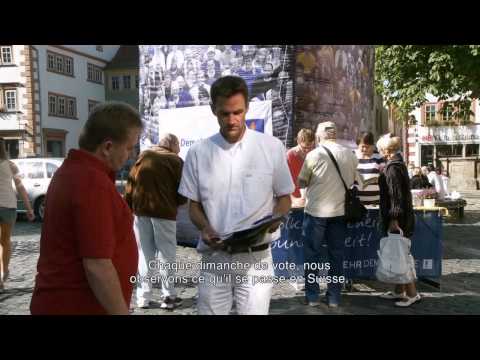
An analysis of the current state of democracy in Switzerland
Social & External
A documentary on assisted suicide, authored by actor and disability rights activist Liz Carr.
Van der Keuken juxtaposes images of Dutch children learning to read against those of the coup d'état in Chile.
A sobering look at the erosion of democracy & freedom of the press in the United States and abroad.
Defilada was made on the occasion of the 40th anniversary celebrations of state's founding in North Korea, which the regime intended to use to eclipse the 1988 Summer Olympics taking place that year in Seoul, South Korea. The North Korean regime invited filmmakers from countries then considered friendly (read: Communist), including People's Republic of Poland, which sent a team under Andrzej Fidyk. The documentary is primarily composed of declarative statements, as well as texts of North Korean newspapers and books. There was no author's commentary. Fidyk commented that he and his team were likely “the most disciplined” foreign team of filmmakers in North Korea, as they did not trouble the regime by looking under the surface - they were content with what they were given and asked to do. (Wikipedia)
Rotterdam 2040 is a film about the city’s future, departing from the principle of Gyz La Rivière that you can’t look ahead without considering your past (something that hasn’t always been Rotterdam’s strongest feature). At high speed, La Rivière reconstructs the history of Rotterdam from the time before the bombings until now, and expands the developments to the year 2040 (100 years after the bombing and the 700th anniversary of the city). La Rivière made a specific choice to expose his personal vision, which is sometimes radical or a little absurd. So no experts and no talking heads, but an assault of old and new imagery, held together by La Rivière as the narrator of the film. Although Rotterdam 2040 deals with architecture and urban renewal, it is actually a film about people. The subjective experience of the city by its (future) occupants mainly determines the parade of architectural blunders and suggestions for the future. All tongue-in-cheek of course.
For the first time, this documentary includes two exclusive interviews with Vladimir Putin and full details about actions in Crimea during spring 2014. These events determined the history of modern Russia. The President talks frankly and openly about the challenges and risks that Russia faced during that time. This film provides the Russian view of the situation. It is impossible to form a complete picture of the world without it.
In 1998, university professor Kembrew McLeod (Associate Professor of Communication Studies at the University of Iowa) trademarked the phrase "freedom of expression" - a startling comment on the way that intellectual property law restricts creativity and expression of ideas. This provocative and amusing documentary explores the battles being waged in courts, classrooms, museums, film studios, and the Internet over control of our cultural commons. Based on McLeod's award-winning book of the same title, Freedom of Expression charts the many successful attempts to push back this assault by overzealous copyright holders. Freedom of Expression is an essential tool for educators, activists, filmmakers, students, artists, librarians, and more.
Through interviews filmed over four years, Noam Chomsky unpacks the principles that have brought us to the crossroads of historically unprecedented inequality – tracing a half-century of policies designed to favor the most wealthy at the expense of the majority – while also looking back on his own life of activism and political participation. He provides penetrating insight into what may well be the lasting legacy of our time – the death of the middle class, and swan song of functioning democracy.
A picture of politicians under pressure, shot during the 1966 elections in Britain. The camera goes to meetings up and down the land, with an eye on angry audience excitement. The result, dramatically and cogently edited, suggests the heat, rather than the light of a campaign. It is crammed with offbeat observation and fascinating sidelights on the techniques of leading politicians in combating commotion
Documentary offering a fresh perspective on the question of how history will judge Donald Trump, by setting his life next to that of a controversial leader from our own past.
An impassioned three-part documentary of the liberation struggle waged throughout Latin America, using Argentina as a historical example of the imperialist exploitation of the continent. Part I: Neo-Colonialism and Violence is a historical, geographic, and economic analysis of Argentina. Part II: An Act For Liberation examines the ten-year reign of Juan Perón (1945-55) and the activities of the Peronist movement after his fall from power. Part III: Violence and Liberation studies the role of violence in the national liberation process and constitutes a call for action.
On 1 January 2021, the UK's transition period with the EU ended and new rules and regulations were agreed at the last minute. This is a time for reflection on the social phenomenon that is Brexit - which has now become a British trademark world-over, alongside the Royal Family, fish and chips and Sherlock Holmes. Brexit Through The Non-Political Glass puts politicians and public sentiments to one side, and seeks the opinions of non-partisan world-class experts - the scholars and professional advisors who specialize in this very topic; no politicians and propagandists, and no social media and populism; among the experts is Vernon Bogdanor, the Oxford tutor of former British prime minister David Cameron, who was consulted before the referendum was offered to the nation; you will hear what his advice was.
We follow the build-up and training of two opposite Belgian political parties. We see their leaders during meetings, during voting and after when the results of the elections are published.
Raised in an orthodox home, Amos Dov Silver dreams of becoming Prime Minister. But when the State continues to shun him, he soon finds unexpected solace in the velvety smoke of Marijuana. Spreading his new Torah, he establishes an online community using a mobile app called "TeleGrass" that turns into the largest marketplace for drugs in Israel, raising Silver to Messiah status. Through exclusive footage of Silver, his family and his partners’ investigations, as well as secretly filmed footage of Silver in the Ukrainian prison, a polarizing portrayal of the man charged with heading a crime organization emerges. Champion of the people, or a lost soul corrupted by power?
This documentary follows Danish prime minister Anders Fogn Rasmussen in the fall of 2002, during Denmark's Presidency of the Council of the European Union. He negotiates the expansion of the EU in Eastern Europe.
The autonomous neighborhood, Freetown Christiania, fights for its survival. Due to its open marijuana trade location, Pusher Street, the Danish government decided in the spring of 2003 to raid the small commune and convert it into a conventional neighborhood.
Intimate portrait of Mogens Lykketoft running for Prime Minister during the weeks up to the Danish Referendum 2005. The documentary deals in particular with his confrontations with the media and his relationship to his spin doctors.
Controversal documentary focusing on events in Afghanistan in 2002 in which Danish soldiers handed over prisoners to the US Army even though USA no longer treated prisoners of war according to the Geneva Convention. Further, the film questions the Danish Prime Minister's reasons for getting Denmark involved in the so-called War Against Terrorism in Afghanistan in the first place.