Documentary about the Cold War.
Social & External
Narrator (voice)
Gorbachev believed that it was impossible to achieve a successful economy until the tensions of the Soviet Union continued with the Western countries, and especially the US, so that their high priority was to tame down, establish relations and negotiate with the Americans.
19 years after the dropping of atomic bombs in Japan, the Olympic Games of 1964 took place in Tokyo. In the midst of the cold war, the games are supposed to become a symbol for a peaceful world. Especially the divided Germany is expected to prove this: By order of the IOC, both German states must participate in Tokyo with a joint team despite deep ideological rifts. The fact that athletes from both German states still had to compete against each other in order to form a joint team for the 1964 Olympic Games in Innsbruck and in Tokyo is all but forgotten. The film tells the story of the East-West German team of 1964 for the first time and is simultaneously a current document about the relation of sports and politics in international relations.
Tensions between the USSR and the United States were high in 1959, with the seemingly constant threat of nuclear war. Then some unlikely ambassadors stepped forward to clear all that away: the Harlem Globetrotters. From Harlem With Love is the story of how a group of barnstorming basketball players traveled to the heart of the Soviet Union at the height of the Cold War and bridged a cultural gap many thought would stand forever.
A disturbing collection of 1940s and 1950s United States government-issued propaganda films designed to reassure Americans that the atomic bomb was not a threat to their safety.
A shocking political exposé, and an intimate ethnographic portrait of Pacific Islanders struggling for survival, dignity, and justice after decades of top-secret human radiation experiments conducted on them by the U.S. government.
Anders Østergaard’s film is an investigative look at the year the Berlin Wall fell, documenting the events that took place in Hungary as a prelude to the dramatic changes in November 1989. The director recreates the events and leads the audiences deep into the politicians’ secret meeting rooms by using a mix of interviews, archive material and reconstructed scenes and dialogues.
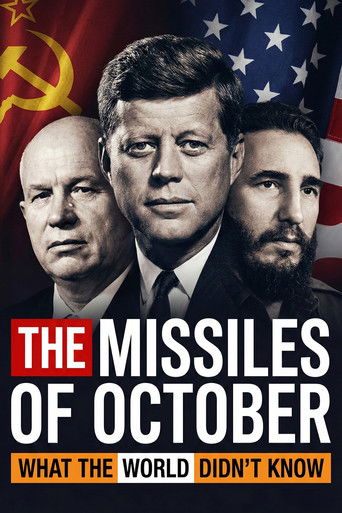
Explore the events of the 1962 Cuban Missile Crisis and hear from some of the actual participants in this riveting program. After an American naval blockade intercepted Soviet submarines on a secret mission to set up a military base in Cuba, the two nations engaged in a tense standoff that led the world to the brink of nuclear war. Submariners from both sides talk about the conflict, and viewers get a look inside their subs and the U.S. war room.
The Polygon shines a light on the village of Sarzhal in East Kazakhstan, situated only 18kms from the perimeter of the former Semipalatinsk Test Site, that was home to over 600 nuclear detonations. Between 1949 and 1991 the Soviet Union detonated 116 above ground bombs, whose massive radioactive mushroom clouds were witnessed by thousands of innocent and unsuspecting Kazakh villagers. They gazed openmouthed at the spectacle, completely unaware that nuclear fallout was raining down on them, their children, livestock and homes. 20 years after the closure of The Polygon they are still suffering high rates of cancer, cancer related diseases and mental illness. The Polygon takes us on a journey from the twisted Cold War experiments to those victims who remain today, still suffering despite the emergence of Kazakhstan as a major economic player on the global stage.
U.S. nuclear tests in space, and the development of the military intercontinental ballistic missile (ICBM).
This film shows how far we have come since the cold-war days of the 50s and 60s. Back then the Russians were our "enemies". And to them the Americans were their "enemies" who couldn't be trusted. Somewhere in all this a young girl in Oklahoma named Shannon set her sights on becoming one of those space explorers, even though she was told "girls can't do that." But she did.
In the aftermath of the Cold War, Russian and American intelligence agencies, once enemies, joined forces and pooled their data to serve the planet, threatened by global warming. The story of a remarkable odyssey.
How in 1959, during the heat of the Cold War, the government of the United States decided to create a secret military base located in the far north of Greenland: Camp Century, almost a real town with roads and houses, a nuclear plant to provide power and silos to house missiles aimed at the Soviet Union.
The riveting biography of 102-year-old CIA spymaster Peter Sichel, who unpacks the obscured roots of conflicts that plague today’s world and the toll espionage took on his personal life.
Made at the height of 'cold war' paranoia, this drama-documentary shows the work of the UK Warning and Monitoring Organisation, who's duties included the issuing of public warnings of any nuclear missile strike and the subsequent fallout.
"McCarthy" chronicles the rise and fall of Joseph McCarthy, the Wisconsin senator who came to power after a stunning victory in an election no one thought he could win. Once in office, he declared that there was a vast conspiracy threatening America — emanating not from a rival superpower, but from within. Free of restraint or oversight, he conducted a crusade against those he accused of being enemies of the state, a chilling campaign marked by groundless accusations, bullying intimidation, grandiose showmanship and cruel victimization. With lawyer Roy Cohn at his side, he belittled critics, spinning a web of lies and distortions while spreading fear and confusion. After years in the headlines, he was brought down by his own excesses and overreach. But his name lives on linked to the modern-day witch hunt we call “McCarthyism.”
Deng Xiaoping's economic and political opening in China. Margaret Thatcher's extreme economic measures in the United Kingdom. Ayatollah Khomeini's Islamic Revolution in Iran. Pope John Paul II's visit to Poland. Saddam Hussein's rise to power in Iraq. The Soviet invasion of Afghanistan. The nuclear accident at the Harrisburg power plant and the birth of ecological activism. The year 1979, the beginning of the future.
A different history of the Cold War: how Estonians under Soviet tyranny began to feel the breeze of freedom when a group of anonymous dreamers successfully used improbable methods to capture the Finnish television signal, a window into Western popular culture, brave but harmless warriors who helped change the fate of an entire nation.
In 1967, in the middle of the Cold War, Joseph Stalin's only daughter goes to the American embassy in New Delhi and asks for asylum. Svetlana leaves behind her country and her two children. Hunted by the press, the KGB, and many admirers, the woman, nicknamed the Kremlin princess, will never cease to flee. From the summit of the Soviet empire to the solitude and poverty of her last years in a Wisconsin home, Gabriel Tejedor traces the destiny of a resolutely free woman, at the very heart of the century and its geopolitical challenges.
During the Cuban Missile Crisis of 1962, Soviet Navy officer Vasily Arkhipov refused to launch a nuclear strike and saved the world from nuclear war and total destruction.
The film documents the conversion of young Greek Military Police (ESA) recruits into torturers and touches on the subject of the power of the institution to compel otherwise moral human beings to torture. The documentary examines the processes and methods of the military junta that ruled Greece from 1967 to 1974.