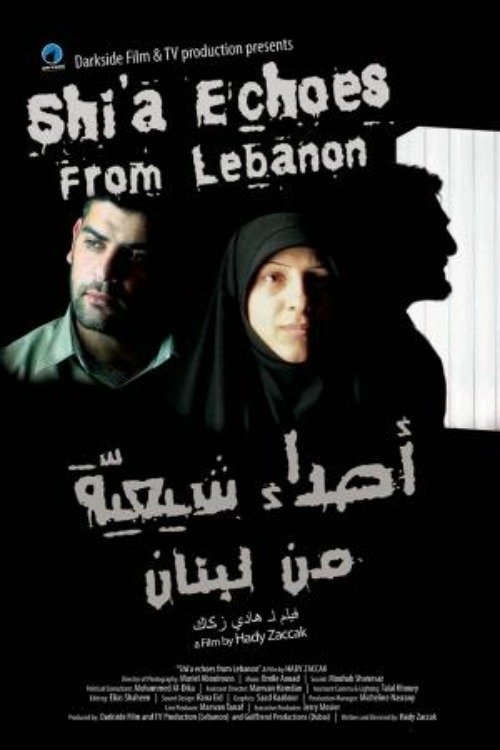
Lebanon is a country hijacked by sects, money, and power. While citizens long for a collective identity to thrive as a community, politicians use the sectarianism for their corrupt ambitions. Unless there is a change, Lebanon will be lost forever.

Social & External
Over the period of 25 years the director met General Võ Nguyên Giáp, a legendary hero of Vietnam’s independence wars, a number of times. She was the first American who entered the home of the “Red Napoleon”. The fruit of this friendship is a film, personal and politically involved at the same time. Travelling across the country and talking to important figures as well as ordinary people, the director finds out more about her roots and offers the audience a unique perspective on Vietnam’s present and past.
A chronicle of the civil uprising against the regime of Ukrainian president Viktor Yanukovych that took place in Kyiv in the winter of 2013/14. The film follows the progress of the revolution: from peaceful rallies, half a million strong in the Maidan square, to the bloody street battles between protesters and riot police.
SOUND OF THE SOUL is a compelling portrait of an Arab country where Muslims, Christians, and Jews have lived together in relative peace for centuries. Beautifully photographed during the Fez Festival of World Sacred Music, the film presents unforgettable performances from groups from Morocco, Ireland, Russia, Afghanistan, Mauritania, the USA, Portugal and France, which carry viewers into what the film's Moroccan sufi guide calls "the hearing of the heart": the essential Oneness at the core of all religions and faiths.
Single mother Anna and her four children live in the front-line war zone of Donbas, Ukraine. While the outside world is made up of bombings and chaos, the family is managing to keep their home a safe haven, full of life and full of light. Every member of the family has a passion for cinema, motivating them to shoot a film inspired by their own life during a time of war. The creative process raises the question of what kind of power the magical world of cinema could have during times of disaster. How to picture war through fiction? For Anna and the children, transforming trauma into a work of art is the ultimate way to stay human.
Bible expert Bill Gallatin explores biblical prophecies from the Book of Revelation that have transpired, with a discussion of whether these events signify that we are now living in the End Times preceding the return of Jesus Christ. Gallatin touches on events such as the increasingly acute difficulties in the Middle East, numerous environmental catastrophes, earthquakes and more, explaining how they connect to scriptural writings.
Starting in 1881 this film shows the personal battle between Lenin's Ulyanov family and the royal Romanovs that eventually led to the Russian revolution.
Following the Prophet Muhammad’s (PBUH) recommendation to journey to three mosques - (in Makkah, Madinah and Jerusalem), this film sets out in the company of British bass player Danny ‘Hamza’ Thompson to discover the reasons why the last of these three holds such an important place in the hearts of Muslims everywhere.
Harold Russell, an American soldier who lost his hands in a training accident, tells the story of his medical rehabilitation at Walter Reed Army Medical Center in Washington DC, how he and his fellow amputees at the hospital at first despaired and then found new hope in the prostheses and training available to amputees through the Army's medical corps. Russell learns to wear and to operate the hooks which replace his hands and becomes competent to perform many tasks he had once thought no longer possible. Discharged from the Army, he is welcomed into Boston College by college president William J. Murphy, S.J.
Hurricane María abated, the news crews packed up and left Puerto Rico, and the interest of the international community turned elsewhere. What happened next?
A series of interviews are conducted concerning people's beliefs towards the possibility of an afterlife. The interviews are filmed against a set of strange backdrops, and are intercut with clips from classic films and a variety of stock footage.
An investigation of "disaster capitalism", based on Naomi Klein's proposition that neo-liberal capitalism feeds on natural disasters, war and terror to establish its dominance.
Julia Sweeney's third autobiographical monologue, Letting Go of God takes the audience through her Catholic upbringing and how personal events in her life and that of her family led her to a disbelief in a personal universal deity.
A rare close-up of the Abakuá —an Afro-Cuban religious brotherhood that has been hidden from outsiders until recently. A symbol of resistance for over 200 years, the Abakuá society has managed to survive slavery, the Spanish domination and the Revolution, spite of all the bias and misunderstandings about their traditions and rituals.
Many times during his presidency, Lyndon B. Johnson said that ultimate victory in the Vietnam War depended upon the U.S. military winning the "hearts and minds" of the Vietnamese people. Filmmaker Peter Davis uses Johnson's phrase in an ironic context in this anti-war documentary, filmed and released while the Vietnam War was still under way, juxtaposing interviews with military figures like U.S. Army Chief of Staff William C. Westmoreland with shocking scenes of violence and brutality.
What threads of history bind Manhattan's Ground Zero to those of Nagasaki and Hiroshima? Or connect sight to truth, games to war, or the silkworm to the drone? What does the United States hold to be the role of science in warfare? How has war historically been waged in Buddhist traditions? These are some of the topics addressed in Eyewar: 80 minutes of found footage which traces the development of the digital image from the maps of the second century to the screens of the twenty-first, and the uses of the field of cybernetics from Japan in the 1940s to Chile in the 1970s and Iraq in the 1990s.
In 2008 French filmmaker Julie Gali traveled to the US to film the election of Barack Obama. In spite of this victory for civil rights, it soon became apparent that the rights of another minority were under threat. In California the passing of Proposition 8 marked the only time in U.S. history that a civil right was actually taken away after it had been granted. Upon seeing this, Ms. Gali decided to immerse herself in the growing grassroots struggle of the gay community, which culminated in the October 11, 2009 March for Equality in Washington DC.
Using historically-accurate, battle-filled re-enactments and interviews with expert historians and noted authors, this two-part documentary series brings to vivid life the captivating true stories behind Britain's bloody civil wars.
Murder, rape, satanism and necrophilia is the staple diet of millions of teenagers who listen to the lyrics of extreme heavy metal music. This World investigates the potential links between "death metal" and a series of gruesome crimes around the world. In Italy a group of young death metal fans formed a satanic cult called the Beasts of Satan. At least four gruesome killings resulted. But death metal musicians deny that they have any responsibility for the actions of people who profess to be their fans. With exclusive access to the families, one of the killers and graphic police footage, the film tells the inside story for the first time. We hear from the musicians, the children and the parents from Oslo to California and ask just how far can music go in its ability to shock, and just how damaging might it be?
Jesus never traveled more than one hundred miles from His birthplace during His three-year ministry, and His life has changed the world.
Twenty years ago, novelist Salman Rushdie was a wanted man with a million pound bounty on his head. His novel, The Satanic Verses, had sparked riots across the Muslim world. The ailing religious leader of Iran, the Ayatollah Khomeini, had invoked a little-known religious opinion - a fatwa - and effectively sentenced Rushdie to death. This film looks back on the extraordinary events which followed the publication of the book and the ten year campaign to get the fatwa lifted. Interviews with Rushdie's friends and family and testimony from leaders of Britain's Muslim community and the Government reveal the inside story of the affair.