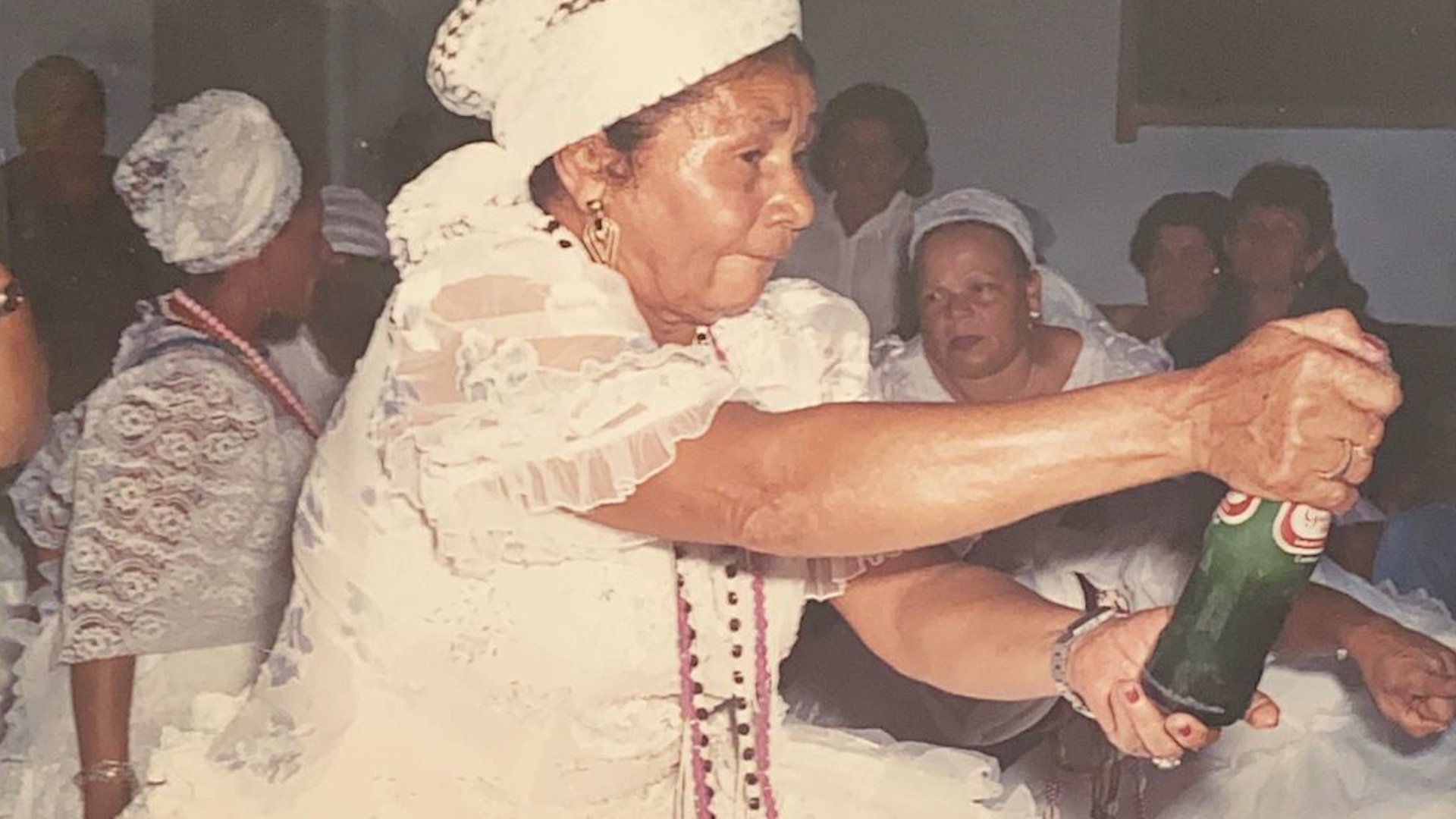
A young anthropologist reflects on her late grandmother's religious background.
Social & External
Self
They call it religion. It's been branded a cult. The lethal handling of serpents. In the name of God. Immolation, speaking in tongues, ecstasy, self injury and the dangerous snakes. The bible belt of the very South. Backyard churches. In West Virginia, Kentucky and Tennessee. Appalachia.
In this authoritative documentary, director Pierre-Henry Salfati traces the history of the Talmud the repository of millennia of Jewish wisdom. In doing so, he posits the question: What comprises this cardinal text of Judaism? Originally passed down orally from master to student, the Talmud is the hidden face of the Torah, or Old Testament. It is a vast body of legal, mythic, and philosophical texts, and a mixture of religious commentary and debate, of history and science, and of anecdote and humor. No other text has had such an influence on Jewish life as it details the principles, ethical codes, and laws that serve as a guide for conduct. In addition to an exhaustive exploration of the Talmud, the film also guides the viewer through the history of Jewish communities, concluding with present-day New York.
With no access to their heritage, four women are forging a new sense of self. In the country that was once the epicenter of the Jewish world, and now regarded as “the Jewish graveyard,” they are figuring out how to be Jewish in today’s Poland.
Marias is a film about the feminine. Visiting the celebrations of the Virgin Mary's (Marias) from Brasil, Cuba, México, Peru and Nicarágua, the director Joana Mariani observes the similarities and disparities among their cultures, and listen to women who have their very particular stories about life, faith and devotion. The result is a very singular film that shows that the image of the Virgin Mary (Maria) is a lot more than a religious figure or the mother of Christ.
YURUMEIN (Homeland) is a documentary film which recounts the painful past of the Caribs on the island of St. Vincent in the Caribbean, their extermination at the hands of the British 200+ years ago, the decimation of their culture on the island, and their exile to Central America where much of that culture survived, even thrived. YURUMEIN (your -o- main) also explores what few cultural remnants of the Caribs, also known as Garifuna, still exist on St. Vincent and the beginnings of a movement to teach and revitalize Garifuna language, music and dance, and ritual to younger generations of Garifuna/ Caribs on St. Vincent.
The story of The Satanic Temple, a controversial movement that combines religion and activism with the apparent purpose of questioning the basic foundations of US society.
Documentary film about Catholic Church teachings about homosexuality. Describes the "third way", the lifestyle lead by orthodox gay Catholics practicing celibacy out of personal choice, an often overlooked demographic in the debates about homosexuality in the Church.
The life of Shona mbira player Gwanzura Gwenzi coexists in both the traditional and modern worlds: he works in the city for a large western corporation; at his rural homestead, he is the family head who hosts all-night spirit ceremonies, called bira. His sister Francisca is the family medium for the spirit of Kaodza, their great-grandfather. The highlight and centerpiece of the film is a bira, perhaps the only one ever completely captured on film. We see the various stages and liturgical components of the ceremony, culminating in the arrival of the spirits late at night. Francisca’s daughter, now-famous mbira player Stella Chiweshe becomes possessed by a snake spirit. Kaodza arrives through Francisca, and the family confers with the spirit in an extraordinary scene that shows how ancestors interact with the living. (Description credit: Villon Films)
With God On Our Side takes a look at the theology of Christian Zionism, which teaches that because the Jews are God's chosen people, they have a divine right to the land of Israel. Aspects of this belief system lead some Christians in the West to give uncritical support to Israeli government policies, even those that privilege Jews at the expense of Palestinians, leading to great suffering among Muslim and Christian Palestinians alike and threatening Israel's security as a whole. This film demonstrates that there is a biblical alternative for Christians who want to love and support the people of Israel, a theology that doesn't favor one people group over another but instead promotes peace and reconciliation for both Jews and Palestinians.
A historical analysis of how groups such as the Nazi’s may use language, symbols, and religious connotation in order to come to power. It raises questions that deserve in depth analysis and consideration. Questions include: Where do legends expand our thinking and where do they bury it? When does spiritual pursuit suddenly turn into fanaticism and violence? Last, have we as a society learned from our past, and if so have forgotten the lessons of the 20th Century? Are we now embarking on a new level only to learn the same old lessons about humanity again? In addressing these questions we are taken into the back drop of the history of Germany beginning in the late 1800’s through the late 20th Century at the eve of the 21st. “A society that does not take archetypes, myths, and symbols seriously will possibly be jumped by them from behind.”
This documentary scrutinizes the Jehovah's Witnesses, and argues that the Watch Tower Society holds tyrannical control over the lives of its members.
Native Mexican people grouped in front of the camera.
Avelino Chillarón was 12 or 13 years old when he realized that his surnames and those of his cousins didn't match, so he decided to ask his uncle. This is how he learned that, although his father and aunt were siblings, they didn't have the same father, so he and his cousins didn't share the same grandfather. In this way, Avelino realized that there was a part of his family he didn't know. The protagonist of this story feels partially mutilated from a part of his family history, a part that was taken away from him by a regime that established, over the years, a long period of widespread social amnesia about a series of corpses and missing persons throughout the spanish geography.
I, Pastafari is a documentary film about the world's fastest growing religion: The Church of The Flying Spaghetti Monster. R'Amen.
The district of Molenbeek-Saint-Jean in Brussels has become world-famous as a center of jihadism, but for six-year-old Aatos and his friend Amine, it is a familiar home. Here, they listen to spiders, discover black holes, and fight about what is going to steer a flying carpet. Together they search for the answers to life's big questions. But the brutality of the adult world makes itself known when terrorists detonate a bomb in the neighborhood. Aaatos envies Amine's Muslim faith and looks for his own gods, although his classmate Flo questions him; she is strongly convinced that anyone who believes in God is completely nuts. Gods of Molenbeek is a wonderful portrayal of childhood friendship, inquiry and the creation of meaning in a chaotic time.
"Our film is about the religious sect of Russian Pentecostals, one of the most reactionary and fanatical cults. Their actions are incompatible with the life and laws of our society. We testify that every frame of this film is documentary."