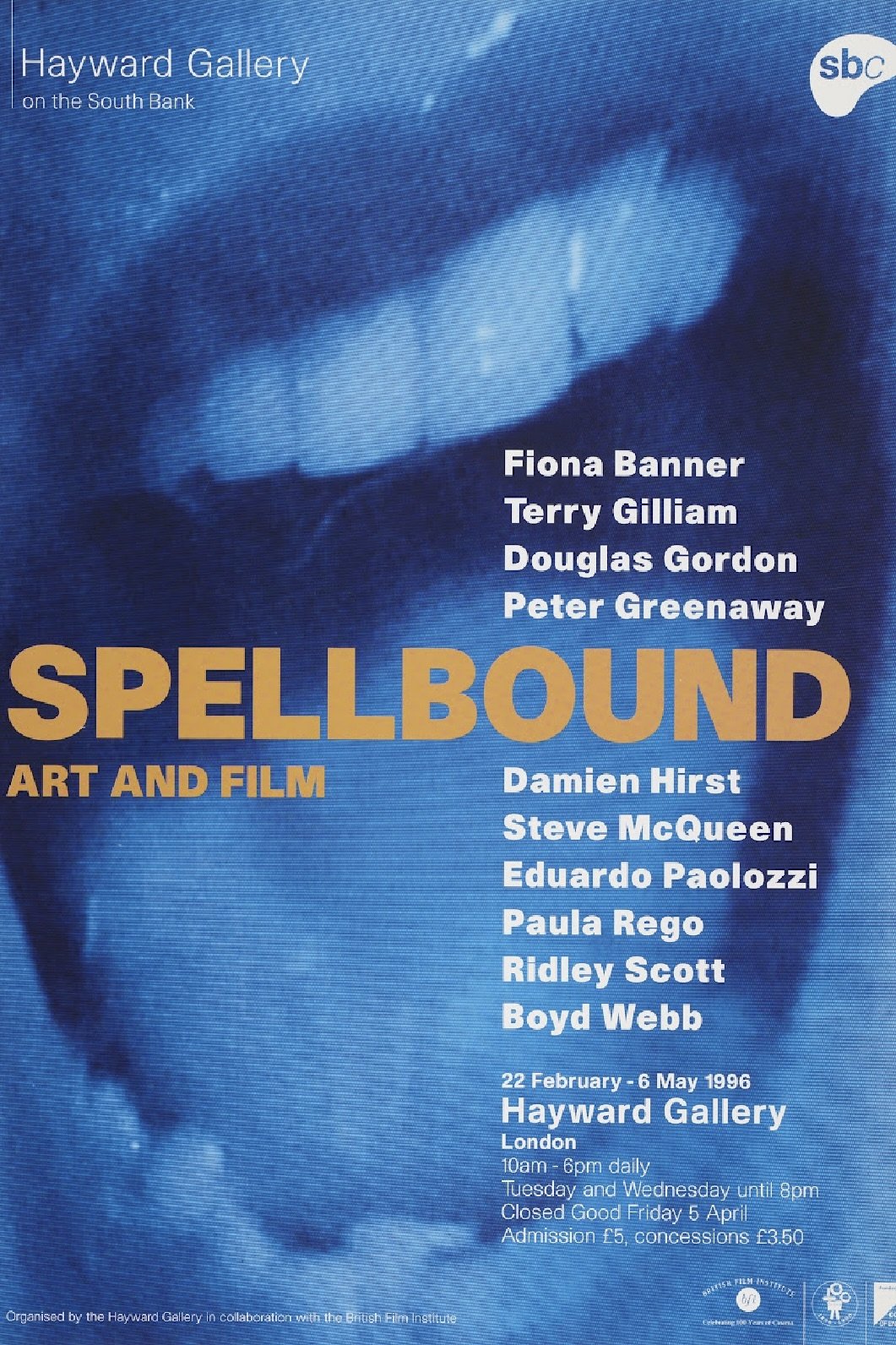
A film as part of the Spellbound installation at the Hayward Gallery in 1996 by Peter Greenaway.
Social & External
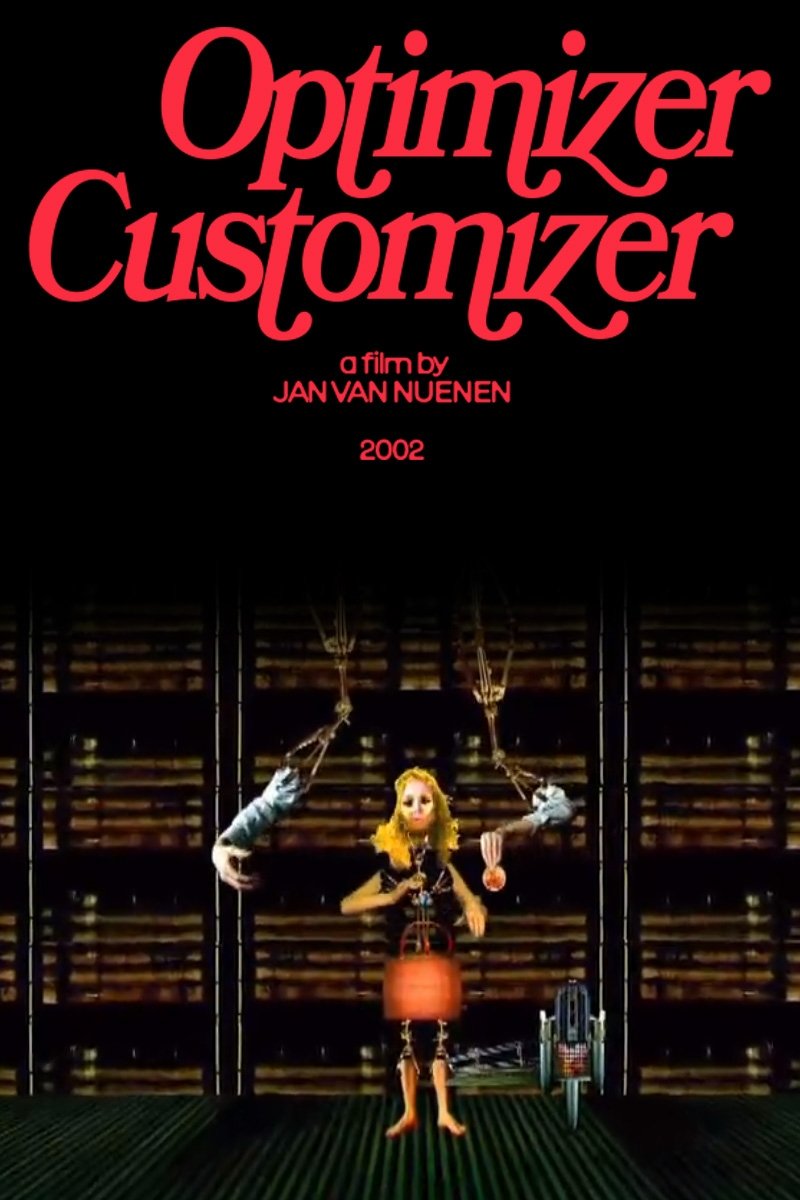
A feminine machine, stuffed with modern nano-technology and useless operations is depicted in this mixed-media 2D animation short, highlighting the consequences of consumerism and the downfall of civilized society. The machine reminiscent of a two-dimensional video game, leads to a destructive chain reaction after a strange malfunction, with people turning into clones and robots.

HIDEO, It's Me, Mama is a psychological melodrama that introduces narrative and structural devices that are integral to Idemitsu's work. Exploring the flawed universe of the contemporary Japanese family, she focuses on a woman's identity as mother through mother-child and husband-wife relationships. Hideo, a young man living away from his parents, is kept under constant surveillance by his doting mother via an omnipresent television monitor. In a cogent metaphor for familial relations in the media-saturated culture of contemporary Japan, Mama can only communicate with her beloved, absent son through the video screen. Idemitsu's poignant irony is embodied in the scene in which Mama, blind to her husband's needs, caresses Hideo's video image. (Electronic Arts Intermix)
Four Poems is a series of video poems in which the horizontal lines of a poem, usually composed of text, have been substituted for horizontal lines of moving image. The piece explores what remains of a poem when its language is removed, and how images might interact with each other in similar or different ways to words. It asks whether rhyme, rhythm, sibilance, or dissonance, might be effectively created by juxtaposing images. It also asks whether arranging images might create a sense of authorship, intentionality, or a tone of voice, in the way that arranging words might. Finally, Four Poems invites the viewer to consider how they might ‘read’ a poem – does a reading have to occur from top-to-bottom, or might new interpretations be possible when the moving parts of the poem can all be seen at once?
Inspired by the “psychic and physical toxicity of life in late capitalism,” Evan Caminiti’s Toxic City Music utilizes sounds sourced from daily life in NYC. These found sounds are heavily processed and woven into instrumentation ranging from electronically treated guitar to modular synthesizers. Toxic City Music evolved over the course of several years, resulting in a wealth of material which will be re-processed and uniquely presented in an improvisatory manner in live performance. The Wire describes the new work as "The sound of things falling apart with unbearable slowness…[with Caminiti] reporting his observations with acuity, integrity, and artfulness."
A series of shots from six 1970s and 1980s horror films are slowed down to near-still moving images. First feature-length piece in the video art series "The Devonsville Train."
An auto-documentary about a disenfranchised Everyman and his struggle to re-integrate himself into society. He fails and turns to crime.
Arbitrary Logic, an interactive audio-visual synthesiser was first presented under the working title Osnabruk at the Osnabruk festival of 1987 and later as part of an improvised and computer music performance with Keith Rowe at the London Filmmakers Cooperative, December 1989.
Ted Hughes's 1993 novel The Iron Woman is the springboard for this multi-media project by Mikhail Karikis. The video section of the installation features seven-year-olds from Mayflower Primary School in East London discussing the novel's environmental themes.
A 1970 projection of what may come when pollution over powers nature.
Short experimental video art by Barbara Sykes.
Furio’s Furious Fragments & Friends - Furio Jesi (1941 Turin -1980 Genoa), enfant prodige moving between a plethora of disciplines – egyptology, history of religions, German philology, literary criticism - passed away prematurely, not without leaving bright fragments which throw light on mechanisms beneath many socio-cultural practices, for instance regarding cultural belonging, the functions of myth in modern society. He saw kind of “mythological machines” at work underneath our cultural production of meanings, historically determined, departing from a void, something that is still in culture but as residue, a missing link to an alleged authentic experience nowadays compromised up to the point to became just rhetoric, a byword, which is in no way neutral, but a tool, a macchina, for maintaining the status quo and serving the power apparatus. As in the case of holidays, celebrations and festivals.
Static Discharge is composed of abstractions created from signal interference. The picture frame is continuously disrupted, as textured lines of feedback distort any form of representation. The flickering movement appears as if fed by an electric current with a faulty conductor - the electronic waves seem to split and repeat themselves without fully transmitting. This is a composition of video noise that creates pulsating tension, a s electricity grinds with flesh, revealing the harsh beauty inherent in a mechanical medium.
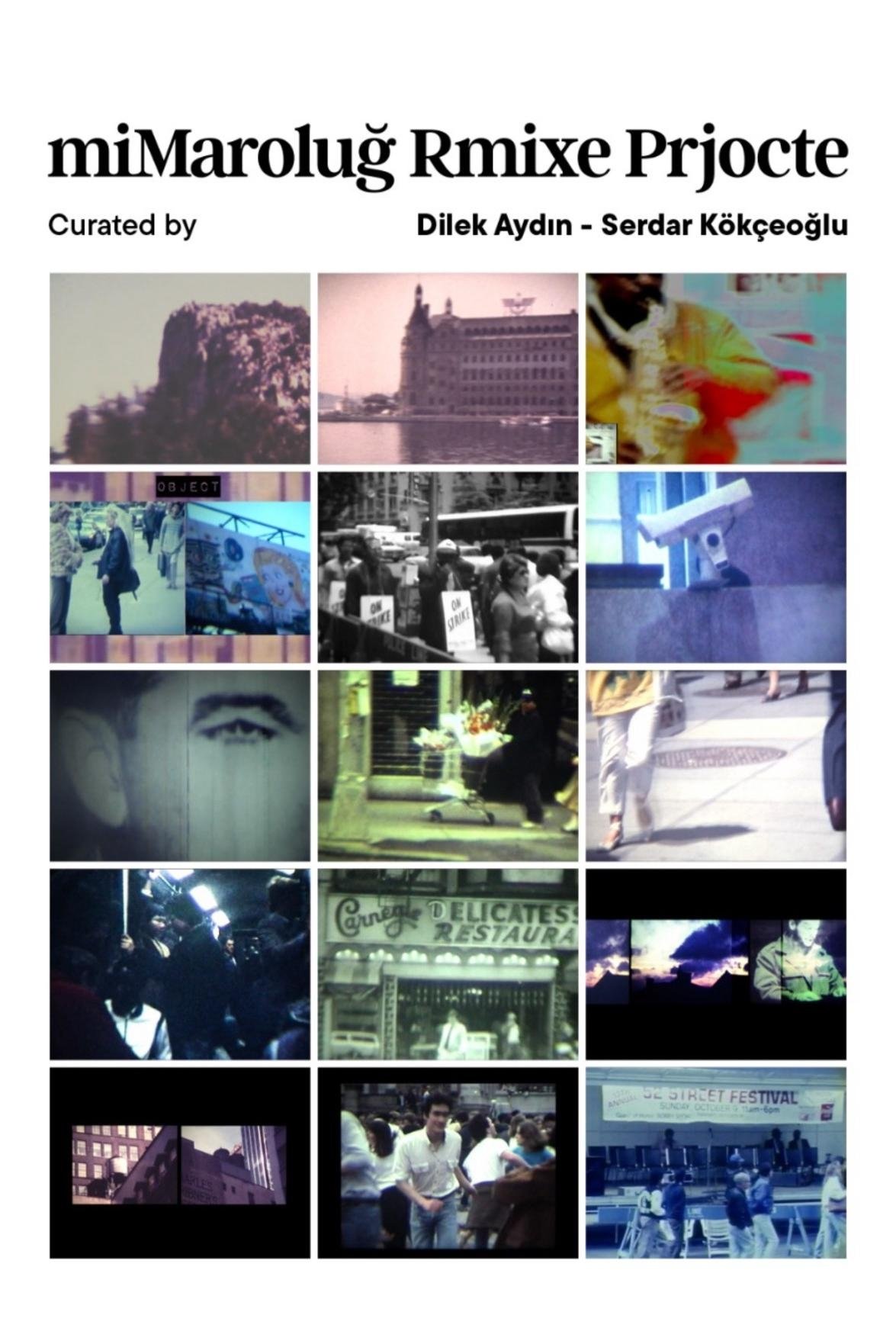
A collection of 8mm film reels from İlhan Mimaroğlu’s archive—once tucked away in whisky boxes—has found new life through art. Curated by director Serdar Kökçeoğlu and producer Dilek Aydın, the project brings together visual artists and musicians to reimagine these long-lost images. Over thirty artists transformed the footage into fifteen distinct audiovisual pieces, blending experimental soundscapes with contemporary video art. The project concludes with a special highlight: the first-ever screening of Mimaroğlu’s silent short film about a street jazz festival, accompanied by Erdem Helvacıoğlu’s dark jazz score.
CREMASTER 3 (2002) is set in New York City and narrates the construction of the Chrysler Building, which is in itself a character - host to inner, antagonistic forces at play for access to the process of (spiritual) transcendence. These factions find form in the struggle between Hiram Abiff or the Architect ...
data-verse is a data-driven audio-visual trilogy by artist and composer Ryoji Ikeda which marks a two-decade culmination in the artist’s research. The trilogy addresses the layered dimensions of our world, from the microscopic, to the human, to the macroscopic. Through Ikeda’s process, massive scientific data sets have been transcribed, converted, transformed, de/re/meta-constructed and orchestrated to visualise and sonify the different dimensions that co-exist in our world between the visible and the invisible. Each variation immerses visitors in the vast data universe in which we live, capturing hidden facets of nature and the vast scientific knowledge underpinning our existence. This large-scale data-driven trilogy is generated by extremely precise computer programming and features a minimalist electronic soundtrack, harmonised with Hollywood-standard, high-definition, 4K DCI video projections of scientific data onto a large screen.
An experimental film comprised of Stanley Kubrick's THE SHINING played forwards and backwards at the same time on the same screen, creating bizarre juxtapositions and startling synchronicities
An experimental media installation of three windows exploring fragments of liminality. Three unique re-constructions of experiential instances volumising the cataclysms of thresholds. Experience the absence of definition, the absence of boundaries set and the absence of rationale. A myth is not to be understood, a myth is passed on, like a game of Chinese whispers, it takes its course and ages with time, suiting the demography and tale, it warps and distorts