Documentary about the life in Berlin in 1941. The planned premier was stopped by the national party due to the damages and painful changes to the city that soon followed. It thus premiered in 1950.
Social & External
himself
herself
voice
Documentary short about the rebuilding of Berlin in 1946 from a Soviet perspective, showcasing the social changes that have taken place since the fall of Hitler and of Jews working side-by-side with non-Jewish counterparts.
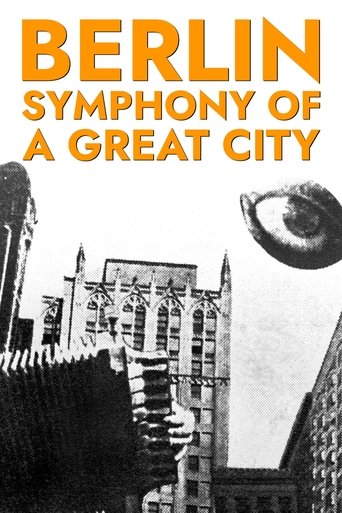
A day in the city of Berlin, which experienced an industrial boom in the 1920s, and still provides an insight into the living and working conditions at that time. Germany had just recovered a little from the worst consequences of the First World War, the great economic crisis was still a few years away and Hitler was not yet an issue at the time.
Journey with the musicians of the Berlin Philharmonic and their conductor Sir Simon Rattle on a breakneck concert tour of six metropolises across Asia: Beijing, Seoul, Shanghai, Hong Kong, Taipei and Tokyo. Their artistic triumph onstage belies a dynamic and dramatic life backstage. The orchestra is a closed society that observes its own laws and traditions, and in the words of one of its musicians is, “an island, a democratic microcosm – almost without precedent in the music world - whose social structure and cohesion is not only founded on a common love for music but also informed by competition, compulsion and the pressure to perform to a high pitch of excellence... .” Never before has the Berlin Philharmonic allowed such intimate and exclusive access into its private world.
The story of the legendary Berlin club and its founder, a woman whose life is inextricably interwoven with the bright and dark sides of a hedonistic lifestyle.
13 August 1961: the GDR closes the sector borders in Berlin. The city is divided overnight. Escape to the West becomes more dangerous every day. But on September 14, 1962, exactly one year, one month and one day after the Wall was built, a group of 29 people from the GDR managed to escape spectacularly through a 135-meter tunnel to the West. For more than 4 months, students from West Berlin, including 2 Italians, dug this tunnel. When the tunnel builders ran out of money after only a few meters of digging, they came up with the idea of marketing the escape tunnel. They sell the film rights to the story exclusively to NBC, an American television station.
The film accompanies Jenny Gröllmann, a German actress, during the last two years of her life.
A taxi drives through the city of Berlin. Its driver is a punk, left and a well-known figure in the autonomous scene. The stations of his trip are the most important places of the autonomous scene: all in the struggle for survival. The last evictions have not yet been processed and the next ones are coming right up.
In the 1960s, a white couple living in East Germany tells their dark-skinned child that her skin color is merely a coincidence. As a teenager, she accidentally discovers the truth. Years before, a group of African men came to study in a village nearby. Sigrid, an East German woman, fell in love with Lucien from Togo and became pregnant. But she was already married to Armin. The child is Togolese-East German filmmaker Ines Johnson-Spain. In interviews with Armin and others from her childhood years, she tracks the astonishing strategies of denial her parents, striving for normality, developed following her birth. What sounds like fieldwork about social dislocation becomes an autobiographical essay film and a reflection on themes such as identity, social norms and family ties, viewed from a very personal perspective.
The film chronicles the story of how the Nazis and the IOC turned, to their mutual benefit, a small sports event into the modern Olympics. The grand themes and controversial issues from the 1936 Games have continued to this day: Monumentality, budget overruns, collusion with authoritarian regimes, corruption and sometimes even bribery.
This documentary explores the creation of the Holocaust Memorial in Berlin as designed by architect Peter Eisenman. Reaction of the German public to the completed memorial is also shown.
Berlin queer community members mourn the substance abuse-related loss of their friends by sharing memories and rituals. Resembling glow-in-the-dark fungi, they radiate light together as a network of support and care.
German TV film, also shown on Spanish TV in 1976, this is a film all about TD which includes informal interviews and concert/studio footage, most of which seems to have been done exclusively for the film. The interviews are in the German language. The street name in the title refers to where Edgar Froese used to live in Berlin (apparently Klaus Schulze lived on the same street at the time) and is now the site of the TDI offices.
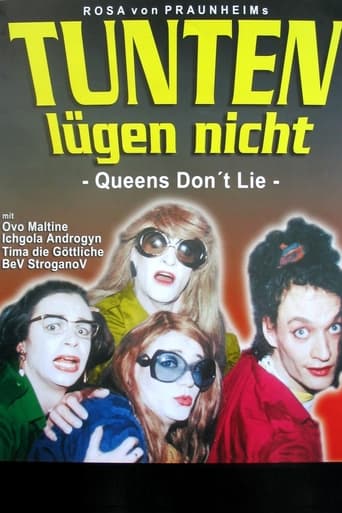
Bosom buddies BeV StroganoV, Ovo Maltine, Ichgola Androgyn and Tima die Göttliche are four Berlin drag queens who met in the mid 1980s. These four queens became Germany’s most popular drag performers and have been busy fertilizing the German cultural scene. Besides being performers, they are also political activists – in AIDS awareness, anti-gay violence, the sex workers movement and the struggle against the extreme right and racism. The film tells their story.
The documentary portrays the art historian Wilhelm von Bode as a realistic visionary.
Documentary examines the history and evolution of the Olympic Games, taking a close look at the Olympic charter, oath and ideals. Also featured are rare home movies and interviews with Olympic athletes and the oldest known color footage of the Olympic Games from Berlin in 1936.
This documentary shows how the Berliner workers lived in 1930. The director Slatan Dudow shows through images: a) the workers leaving the factory; b) the raise of the rents; c) the "unpleasant" guest, meaning the justice officer that brings the eviction notice; d) the fight of classes of the houses of capitalists and working classes; e) the parks of the working class; f) the houses of the working class, origin of the tuberculosis and the victims; g) the playground of the working class; h) the swimming pool for the working class, ironically called the "Baltic Sea" of the working class; i) the effects of humidity of basement where a family lives, with one member deaf; j) one working class family having dinner while the capitalist baths his dog; k) the eviction notice received from an unemployed family and their eviction.
A documentary about the clashes between squatters and the police in Berlin in early 1981. Despite the absence of commentary, this is an openly partisan film that aims less for political analysis than for an up-close description of the situation and mood.
The film is a story about the deep connection of the life and art of the artist. It takes you on a journey through Berlin like you have never seen before. Take a deep dive behind the scenes of the famous red and blue graffiti letterings that cover the heart of the city and tune into the connection between art, letters and spirituality.
Cord Hosenbeck and Tish Cattigan return for their annual round of live Rose Parade coverage. Cord Hosenbeck and Tish Cattigan are no strangers to the iconic New Year’s tradition of the Rose Parade, having covered the event for the past twenty-six years. After a whirlwind year that included traveling abroad to cover the Royal Wedding, the duo are more excited than ever to return to Pasadena. The esteemed Tim Meadows will also return for the festivities.
This documentary looks at the Danish resistance movement's execution of 400 informers during the Nazi occupation and the ensuing cover-up.
"This piece, with the generic title Film, is a series of short videos built around one protocol: a snippet of news from a newspaper of the day, is rolled up and then placed on a black-inked surface. On making contact with the liquid, the roll opens and of Its own accord frees itself of the gesture that fashioned it. As it comes alive in this way, the sliver of paper reveals Its hitherto unexposed content; this unpredictable kinematics is evidence of the constant impermanence of news. As well as exploring a certain archaeology of cinema, the mechanism references the passage of time: the ink, whether it is poured or printed, is the ink of ongoing human history." –Ismaïl Bahri
When Marty's car is stolen, he sets out on a mission to find it; however, he soon realizes that the person who stole it is much more dangerous than he thinks.
A female FBI agent holidaying in Eastern Europe with her family gets her life upside down when her daughter is kidnapped. She has to team up with a criminal on the run to save her daughter before time runs out.
Shimmy, a monkey newly discover superhero powers and learns how to control his extraordinary transformative abilities and prevent powerful demonic forces from sending the universe into chaos.
Clémence, the fearless mayor of a town near Paris, is completing the final term of her political career. With her faithful right-hand man Yazid, she has long fought for this town plagued by inequality, unemployment and slumlords. However, when Clémence is approached to become Minister, her ambition arises, questioning her devotion and commitment to her citizens. Will her political integrity and election promises survive her newly found ambition?
A band of vikings are on the run from a blood thirsty group of Berserkers who want to fight to the death.
A pioneering family fights back against a gang of vicious outlaws that is terrorizing them on their newly-built farm on the plains of Montana.
Before the three feature films, Mario Schifano directs the camera towards the people around him to create real film diaries. His friends, his time partner and the artists he frequented are portrayed in their everyday life or object of the mechanical gaze of the camera, a filter through which to look at the outside world.
Jane lives with her brother Chut with her being the only one doing everything around the house. But Chut will need to learn to take care of himself when Jane becomes involved romantically with a Japanese coworker.
A teenage girl makes a wish that shrinks her to the size of her childhood toys, which magically come to life.
Alba has Down's Syndrome and was left in the hospital when she was born. Thirty families rejected her before the court decided to entrust her to Luca: a Catholic — and gay — single man.
A man is imprisoned for a crime he didn't commit. When his wife is murdered and his son kidnapped and taken to Mexico, he devises an elaborate and dangerous plan to rescue his son and avenge the murder.
Liza scores an invite to one last wild party before the world ends. But making it there won't be easy, as her car has been stolen, and the clock is ticking on her plan to tie up loose ends with friends and family. Accompanied by her younger self, Liza embarks on a hilarious journey across Los Angeles, running into an eclectic cast of characters.
The Imjin War reaches its seventh year in December of 1598. Admiral Yi Sun-shin learns that the Wa invaders in Joseon are preparing for a swift withdrawal following the deathbed orders of their leader Toyotomi Hideyoshi. Determined to destroy the enemy once and for all, Admiral Yi leads an allied fleet of Joseon and Ming ships to mount a blockade and annihilate the Wa army. However, once Ming commander Chen Lin is bribed into lifting the blockade, Wa lord Shimazu Yoshihiro and his Satsuma army sail to the Wa army's rescue at Noryang Strait.
When the world is gripped by a plague unleashed by the evil lord Chaos, and humans are turned into rabid creatures, mankind can only be saved by three young women, descendants of a Goddess, with the power to stop Chaos' evil.
A young man, plagued by the music in his head, has to come to terms with an uncertain future while balancing love, family and Brazilian culture in Newark, New Jersey.
Billionaire sportsman Buddy King unwinds by hunting human captives on his remote mountain estate. But his latest victim, Ava Bravo, is no easy target.